Incremental Games: Why Numbers Going Up Never Gets Old
Incremental games are built on one simple promise: the number will go up. You start with almost nothing, you earn a little, you spend it on something that earns more, and the cycle repeats until the numbers on your screen are billions of times bigger than where you began.
Described like that, it sounds like the least exciting idea in gaming. Yet incremental games have a huge, loyal audience, and people happily keep a tab open for weeks to watch their progress grow. This post looks at what makes an incremental game tick: the math under the hood, the layers that keep it fresh, and why “number goes up” is so hard to stop watching. The examples come from Spacebar Clicker, a free incremental clicker in a retro Windows 98 style, so every figure here is one you can check in the game.
What is an incremental game?
An incremental game is any game where the main source of progress is a growing number, and where most of your decisions are about making that number grow faster. The name comes from the steady increments: each purchase adds a little more, and those additions compound.
You’ll also hear these games called idle games or clicker games. The terms overlap a lot:
- Incremental describes the big picture: progress through ever-growing numbers.
- Clicker describes the active part: pressing or tapping to earn.
- Idle describes the passive part: earning while you do nothing.
Most games in the genre are all three. Spacebar Clicker starts as a clicker (your space bar earns $1 per press), turns idle as soon as your devices earn automatically, and stays incremental the whole way through. If you’re brand new to the genre, our beginner’s guide to idle clicker games covers the basics.
The number at the center of everything
Every incremental game has one number that matters more than any other. In Spacebar Clicker it sits at the top of the screen in huge green pixel digits: your balance.
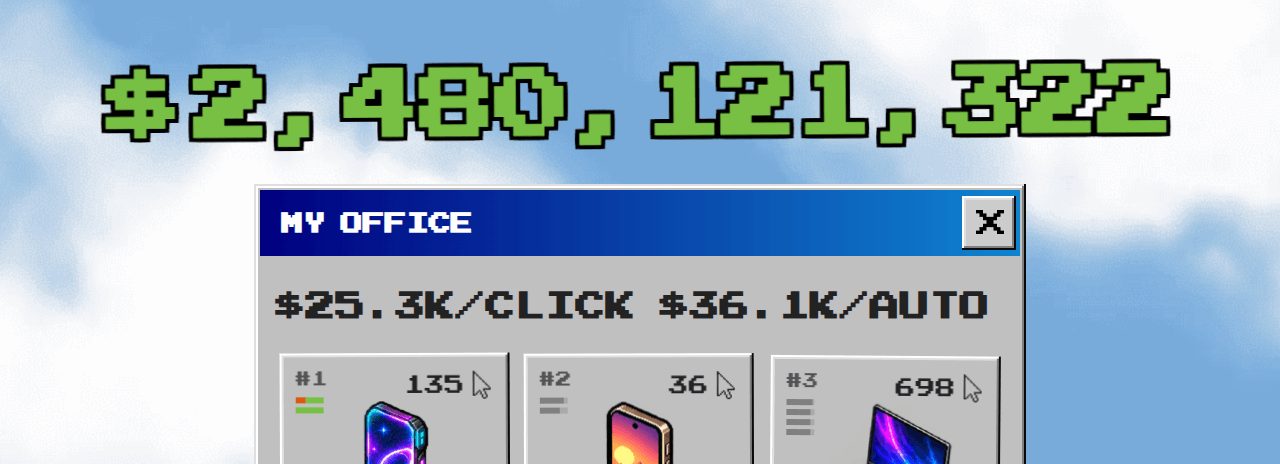 A late-game balance. The office below it earns $25,300 per click and $36,100 per production cycle.
That number does a lot of work. It’s your score, your currency and your progress bar all at once. Every time it grows, you’re closer to your next purchase. Every time you spend, it drops, and you immediately start watching it climb back. The game gives it a little pop with every press of the space bar, so even a single click feels like it moved something.
Under the balance, the office window shows two more numbers: what one click earns, and what your devices earn on their own. Those are the two engines of the game, and almost every decision you make is about growing one or the other.
The math that makes it work
Here’s the part most players never think about, but feel all the time. An incremental game is a race between two curves: how fast costs rise, and how fast rewards rise. Get the balance right and the game always feels like it’s moving. Get it wrong and it either ends in an hour or stalls forever.
Spacebar Clicker uses three main growth rates:
| What grows | How fast | What it means |
|---|---|---|
| Cost of each upgrade level | +27% per level | The next level is always a bit further away |
| Reward of each upgrade level | +10% per level | Each level still adds more than the last |
| Price of each extra device of the same type | +22% per copy | Your fifth PC costs far more than your first |
Costs grow faster than rewards. That’s on purpose. It means any single upgrade eventually gets expensive enough that something else becomes the better buy, which pushes you to spread your money across many parts and many devices instead of pouring it all into one.
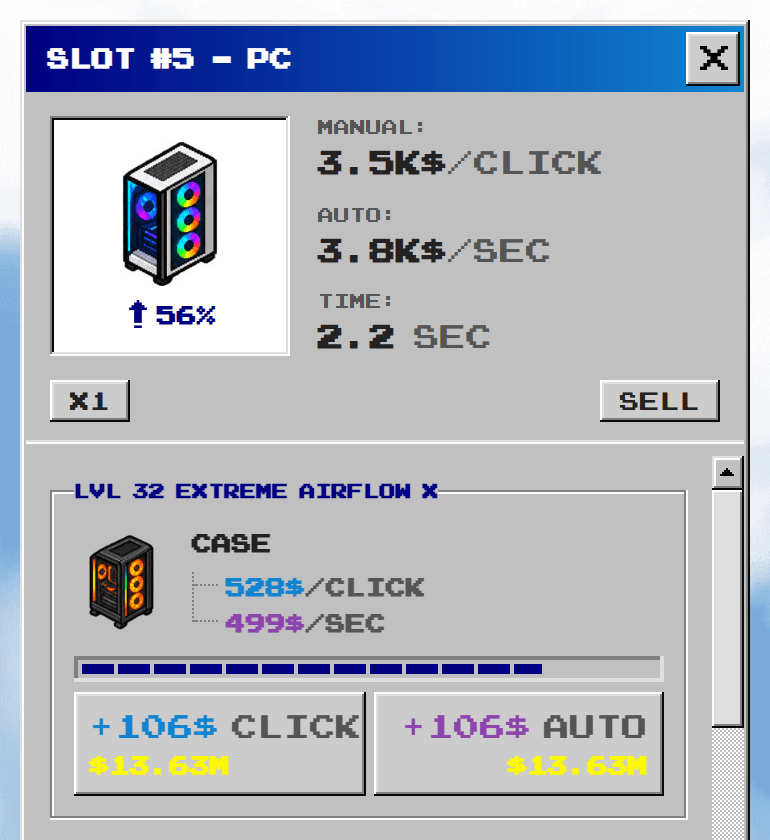 A PC late in the game. The next level of its case costs $13.63 million and adds $106. That’s the cost curve at work.
At the same time, you keep unlocking things with much bigger base numbers. A phone starts at $500, a laptop at $4,000 and a PC at $23,000. A server costs $23 million, and a Miner costs $1.275 billion. Each new tier resets the race: its first levels are cheap compared to what you now earn, so progress suddenly feels fast again. That rhythm of slowing down and speeding up is the heartbeat of every good incremental game.
Why the numbers get so big
Because rewards compound, incremental games quickly outgrow normal numbers. Your first click earns $1. A few hours later a click is worth thousands. Later still, a single production cycle brings in more than your first hour of play.
That’s why incremental games shorten their numbers. Spacebar Clicker uses K for thousands, M for millions, B for billions and T for trillions on buttons and tiles, so a price like $13.63M fits in a small button. Only your main balance is written out in full, which makes every extra comma feel like a milestone.
The scale goes a long way. The most expensive room in the game costs $5 trillion, five trillion times your first click.
Layers: the secret to staying fresh
If an incremental game only made numbers bigger, it would get boring fast. The best ones add new layers as you go, each with its own rules. Spacebar Clicker stacks them like this:
- Clicking. Your space bar earns money, and a speed meter multiplies clicks up to x4 when you press fast.
- Devices. Phones, laptops and PCs earn per click and automatically on a timer.
- Parts. Every device has parts to level, and you choose whether each level boosts clicks or automatic income.
- Unlocks. Servers appear after three PCs. Miners appear after three servers and a Mining license.
- Rooms. Each room is a 3 by 3 grid of slots, and there are nine rooms to buy.
- Enhance. Maxed-out parts can be enhanced with up to eleven stars, multiplying what they earn by as much as x10.
- Mining rigs. Miners take GPU or CPU cards, with card slots, sync bonuses and lucky crits.
Each layer arrives right around the time the previous one starts to feel familiar. That’s the real trick of the genre: you’re never just making the same number bigger, you’re constantly learning a new way to make it bigger. The Enhance layer adds a bit of luck on top, which we cover in detail in our guide to RNG in incremental games.
Goals on every timescale
Another thing good incremental games do is give you goals of every size at the same time:
- Seconds: the next cheap upgrade level.
- Minutes: a new device or a new slot.
- Hours: unlocking servers or filling a room.
- Days and weeks: Miners, the last rooms and eleven-star parts.
Achievements tie all of this together. Spacebar Clicker has 110 achievement levels across 11 tracks, from total clicks to fully built PCs and servers. Each level pays a cash reward, so achievements feed straight back into the number.
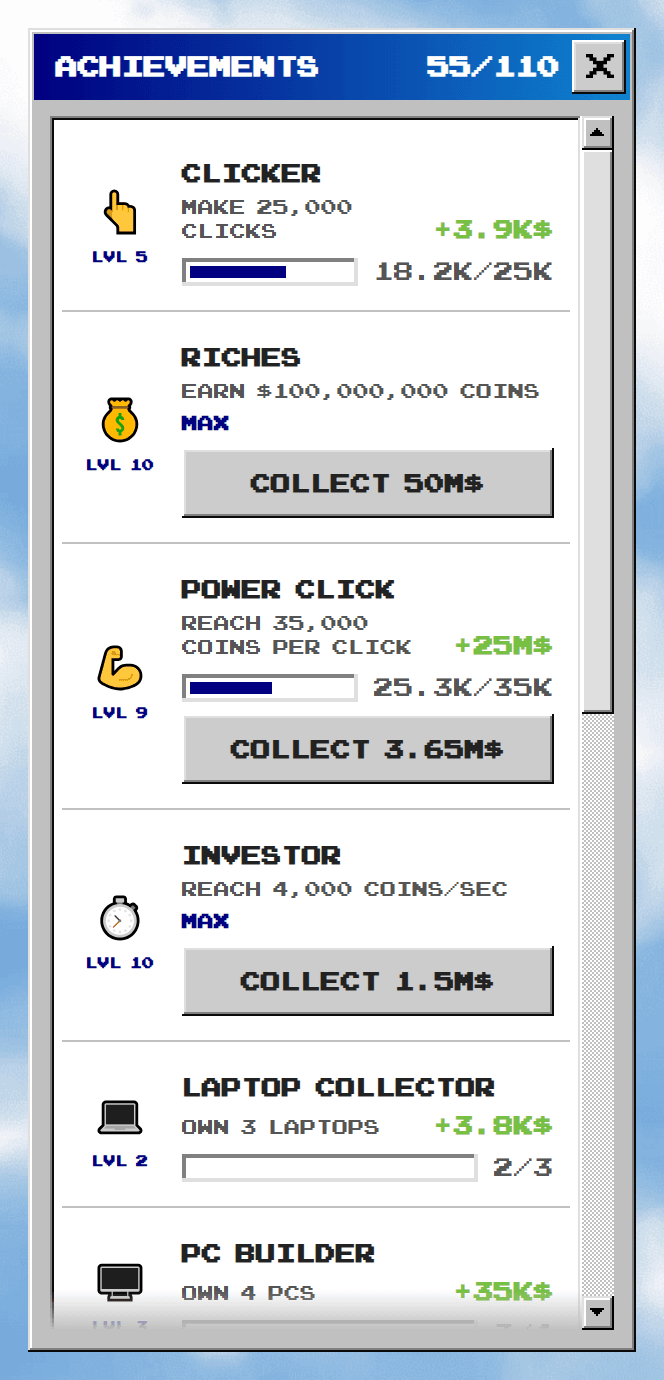 55 of 110 achievements. Some tracks are maxed out, while others still have long climbs ahead.
Some tracks fill up in a day. The top Clicker level asks for two million presses of the space bar. There’s always something close and something far away, which is exactly what keeps you coming back.
Why “number goes up” feels so good
So why does a growing number hold our attention so well? A few reasons:
Progress is always visible. In most games, progress hides behind skill or luck. In an incremental game it’s right there in big digits, going up even while you watch.
Effort always pays. Every click and every purchase moves you forward. Nothing gets taken away, and there’s no game over.
Growth surprises you. Because rewards compound, you constantly hit moments where you realize you’re earning in a second what used to take an hour.
It respects your time. Incremental games keep working while you’re away. Spacebar Clicker counts up to 24 hours of automatic income while the game is closed, so a night’s sleep turns into a pile of money waiting to be spent.
Decisions stay meaningful. Because costs outrun rewards, the best purchase keeps changing. There’s always a small puzzle to solve: this level, that device, or save for the next unlock?
How to get more out of an incremental game
A few habits make any incremental game more fun and more rewarding:
- Spend often. Money sitting in your balance isn’t growing anything. Early on, buying something now beats saving almost every time.
- Compare value, not price. Look at what an upgrade adds for its cost. A cheap level that adds a little often beats an expensive one that adds a lot.
- Watch for new layers. When something new unlocks, its first levels are usually the best deals in the game.
- Use both engines. Click income helps when you’re playing actively, automatic income carries you while you’re away. A mix of both works best.
- Come back regularly. Short, frequent visits let you reinvest your earnings sooner, and reinvesting is what makes the numbers compound.
Quick answers
What are incremental games? Games where progress comes from a growing number, and your choices are about making it grow faster. They’re also called idle games or clicker games.
Are incremental games the same as idle games? Mostly. “Incremental” describes the growing numbers, “idle” describes earning while you’re away. Most games in the genre are both.
Do incremental games ever end? Good ones last a very long time. Spacebar Clicker has nine rooms, eleven-star parts and achievements that take millions of clicks, so there’s always another goal.
Is Spacebar Clicker free? Yes. It’s free to play in your browser with nothing to download.
Watch your own number grow
The best way to understand incremental games is to start one from zero. Open Spacebar Clicker, press the space bar for your first dollar and see how long it takes until your balance needs commas. When you’re ready to plan ahead, our guide to every device shows what each tier costs and when it unlocks.