What Is an Idle Clicker Game? A Beginner's Guide
An idle clicker game is a game where you start by clicking to earn something, then spend what you earn on things that earn it for you. Before long the game is mostly playing itself, and your job shifts from clicking to deciding what to buy next.
That one sentence covers the whole genre, but it doesn’t explain why so many people find these games hard to put down. This guide walks through how idle clickers work, the words people use to describe them, and what to focus on when you play your first one. The examples come from Spacebar Clicker, a retro Windows 98 style idle clicker that runs in your browser, so every number here is a real one you can check.
The core loop in one picture
Almost every idle clicker runs on the same loop:
- Click to earn currency by hand.
- Spend that currency on something that earns automatically.
- Wait (or keep clicking) while income piles up.
- Upgrade to make everything earn faster.
- Repeat, at a bigger scale each time.
The trick is that each pass through the loop is faster than the last. Early on, a single upgrade might double your income. Later, you’re juggling dozens of upgrades that each make a small difference, and the numbers on screen are many times bigger than when you started.
Clicking: the active part
Every idle clicker starts with a button. In Spacebar Clicker it’s a big Spacebar key at the bottom of the screen. You press the real space bar on your keyboard, or tap the button on a phone, and each press earns money.
At the very start, one press is worth $1. That’s slow on purpose. Clicking is how you get things moving, but it isn’t meant to carry you forever. The first goal is always to turn that hand-earned money into something that earns without you.
Some idle clickers reward fast clicking directly. Spacebar Clicker has the Gainer: if you click quickly, a meter fills up and every click gets multiplied. Clicking at around 4 clicks per second gets you the first bonus, and the multiplier climbs as you go faster, up to x4 at about 19 clicks per second. Slow down and it drops back. It turns plain clicking into a small rhythm game.
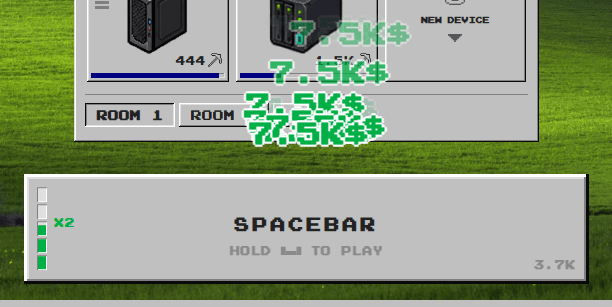 A fast burst of clicks fills the Gainer meter on the left of the button. Here it’s at x2.
Automation: the idle part
The “idle” in idle clicker refers to income that comes in without any clicking. In Spacebar Clicker, that comes from devices and the Auto upgrades you put into them.
You start with a basic phone in your first slot. At first it only adds to your clicks. Every upgrade level you buy lets you choose what it improves, and the levels you put into Auto make the device pay out on a timer, every few seconds, whether you’re clicking or not. As you earn more, you buy new slots in your My Office grid and fill them with laptops, PCs, and servers, each with its own upgrades.
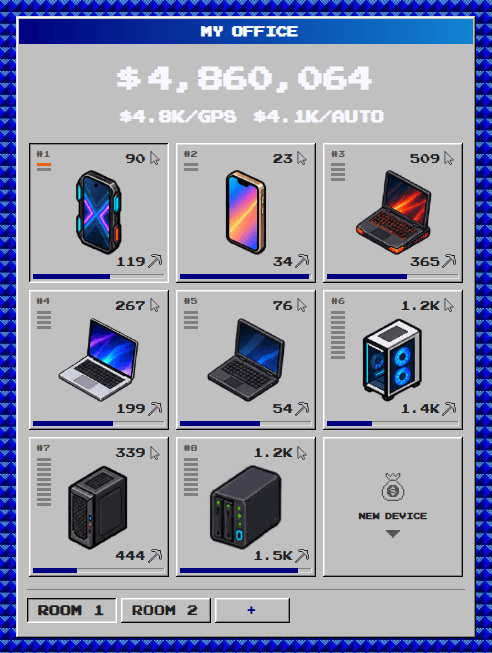 A mid-game office. Each tile shows what that device adds per click (top) and per second (bottom).
This is the moment the genre clicks for most people. The first time you notice money going up while your hands are off the keyboard, you understand what the game is about.
Upgrades and growing costs
Upgrades make your devices better. In Spacebar Clicker, each device has components you can level up one step at a time. Some upgrades add to what you earn per click, some add to what a device earns automatically, and some make devices pay out more often.
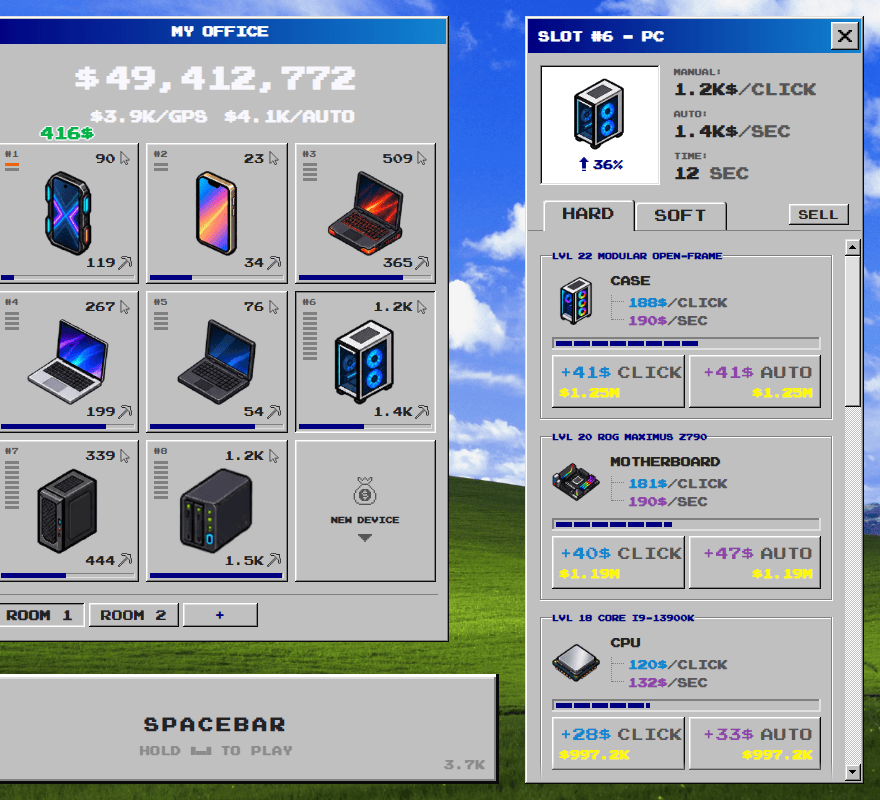 A PC’s components. For each level you buy, you pick what it improves, here either clicks or automatic income.
Every upgrade costs a bit more than the one before it. In Spacebar Clicker each level costs about a third more than the last. That rising cost is what keeps an idle game interesting. If upgrades stayed cheap, you’d buy everything at once and have nothing left to aim for. Because costs climb, you always have a next target that’s just out of reach.
The same goes for new slots, which you buy before you can place a device in them. In Spacebar Clicker, your second and third slots cost $1,000 each, the next row costs $35,000 per slot, and the row after that is $220,000 per slot. When your office is full, you can open a new room with its own grid, up to four rooms in total.
Offline progress: earning while you’re gone
Most idle games keep counting while you’re away, and this is a big part of their appeal. In Spacebar Clicker, when you come back to the game it works out what your devices would have earned while you were gone and adds it to your balance. Time away counts for up to 24 hours.
That changes how you play. Instead of one long session, you can play in short visits: spend your money, set up your next goal, close the tab, and come back later to a pile of cash. It’s a game that fits around your day rather than asking for it.
Idle, clicker, incremental: are they the same thing?
You’ll see three words used for this genre, often interchangeably. They overlap a lot, but each one leans on a different part of the experience:
| Term | What it emphasizes |
|---|---|
| Clicker | The active part: pressing a button to earn. |
| Idle | The passive part: earning while you do nothing. |
| Incremental | The big picture: numbers that keep growing step by step. |
Most games in the genre have all three. “Idle clicker” is the most common way to describe a game that starts with clicking and grows into automation, which is exactly what Spacebar Clicker is.
Why idle games feel so satisfying
On paper, a game about watching numbers go up sounds dull. In practice, it’s one of the most relaxing kinds of game there is, for a few reasons.
Progress is always visible. There’s always a number getting bigger. Even a short session moves you forward, and you can see it happen.
Goals are short and clear. “Afford the next upgrade” is a goal you can hit in a minute. Hitting it unlocks the next one, and that steady chain of small wins keeps you going.
There’s no game over. Nothing you build gets taken away. If you stop for a day, your devices kept working the whole time, so stepping away doesn’t set you back.
Growth surprises you. Because upgrades build on each other, your income doesn’t grow in a straight line. There’s a moment in every idle game where you look at a number and realize it’s thousands of times what you started with. That moment is a big part of the fun.
It asks for very little. You can play with one hand, during a phone call, or in the gap between two other things. That low commitment is a feature, not a flaw.
Achievements and goals
Idle games usually give you longer-term goals on top of the moment-to-moment loop. In Spacebar Clicker these are achievements. There are 11 achievement tracks, such as total clicks, total money earned, and devices owned, and each track has 10 levels for 110 in total.
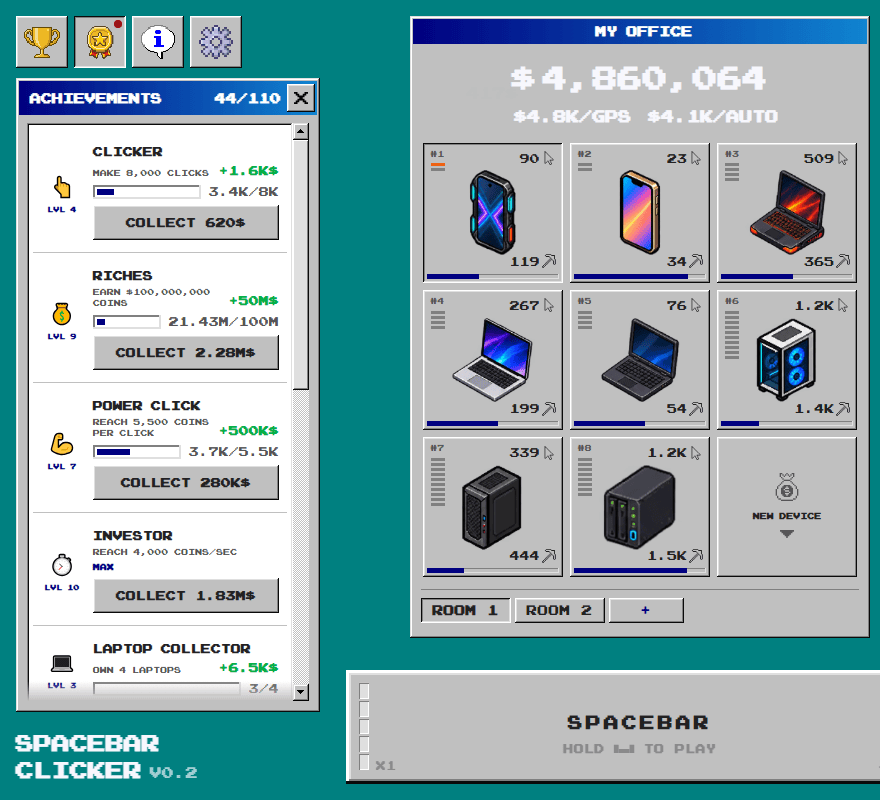 Each track shows progress toward its next level. Finished levels wait for you to collect the reward.
Every level pays out a money reward when you collect it, so achievements aren’t only a trophy shelf. They feed straight back into the loop and help you afford your next upgrade.
Beginner tips for your first idle game
These apply to most idle clickers, and to Spacebar Clicker in particular.
Get automatic income early. Clicking is fast at first, but automation is what scales. In Spacebar Clicker, put some of your first upgrade levels into Auto so your phone starts earning without you.
Spend often. Money sitting in your balance isn’t doing anything. In the early game, it’s almost always better to buy the next upgrade now than to save up.
Look for the cheapest real improvement. When you’re unsure what to buy, compare what an upgrade adds against what it costs. A cheap upgrade that adds a little often beats an expensive one that adds a lot.
Click in bursts. If the game rewards fast clicking, like Spacebar Clicker’s Gainer, short fast bursts are worth more than slow steady clicking.
Close the game sometimes. It sounds odd, but stepping away is part of the design. Offline earnings mean a break is still progress, and coming back to a big balance is one of the best moments in the genre.
Check your achievements. They’re a free source of extra money, and they point you toward things you might not have tried yet.
Where idle games run
Idle games have been around on almost every platform, from browser tabs to phones to desktop stores. Browser idle games have a special advantage: there’s nothing to install. You open a page and you’re playing, which is also why they’re popular on school and work computers. If that’s where you plan to play, our post on whether Spacebar Clicker is unblocked covers what to expect.
Spacebar Clicker runs in any modern browser on desktop and mobile. On a computer you use the space bar, and on a phone you tap the big button.
Quick answers
What is an idle clicker game? A game where you click to earn currency, then spend it on things that earn automatically, so the game gradually plays itself.
Do idle games really play themselves? Partly. Automatic income keeps coming in while you’re away, but you still decide what to buy, and those choices shape how fast you grow.
Are idle clicker games free? Many are. Spacebar Clicker is free to play in your browser with no download.
How long does it take to get into one? About a minute. The first click teaches you the first rule, and the game introduces everything else as you earn enough to use it.
Try your first one
The fastest way to understand an idle clicker is to play one for five minutes. Open Spacebar Clicker, press the space bar a few dozen times, buy your first upgrade, and watch what happens to your income. You’ll get the idea long before your first coffee break is over.