Spacebar Clicker Enhance Guide: RNG Upgrades Explained
Most of an incremental game is predictable. You buy an upgrade, your income goes up by a known amount, and you buy the next one. That steady, reliable growth is a big part of why the genre is so relaxing. But a lot of players also love a bit of risk on top, which is where “RNG incremental” games come in: idle games where some of your progress comes from a roll of the dice.
Spacebar Clicker is mostly a predictable game, with one exception. Once you max out a part, you can try to Enhance it. Each attempt costs money, can succeed or fail, and every success multiplies everything that part earns. This guide covers exactly how Enhance works, with the real numbers from the game, and when it’s worth gambling on.
What “RNG incremental” means
RNG stands for random number generator. In games it’s shorthand for anything decided by chance: loot drops, critical hits, rolls and pulls. An RNG incremental game mixes that randomness into the usual idle loop, so instead of every upgrade being a sure thing, some of them are a gamble.
There are two broad flavors:
- Games built around RNG, where rolling is the main activity and luck decides most of your progress.
- Games with an RNG layer, where the core is predictable and randomness is an optional extra for players who want it.
Spacebar Clicker is the second kind. Clicking, buying devices, upgrading parts and collecting achievements all work exactly the same every time. Enhance is the single place where luck comes in, and you choose whether and when to use it. If you’re new to the genre in general, our beginner’s guide to idle clicker games covers the predictable part first.
Where luck does (and doesn’t) matter in Spacebar Clicker
It’s worth clearing up one common mix-up. The game has two systems that can feel similar:
- Click Boost is a timing minigame. You hold the button, then stop a sweeping needle inside a target zone to grow a multiplier for your next click. It feels tense, but it’s a skill test: better timing gives better results.
- Enhance is pure chance. Nothing you do changes the odds of a roll. The only decisions are which part to enhance and when to stop.
So if you’re looking for the RNG part of the game, it’s Enhance.
How Enhance works
Every part of every device has a maximum level. A phone body maxes out at level 25, for example, and its cooler at 20. As soon as a part hits its max level, its normal buy buttons are replaced by an Enhance button.
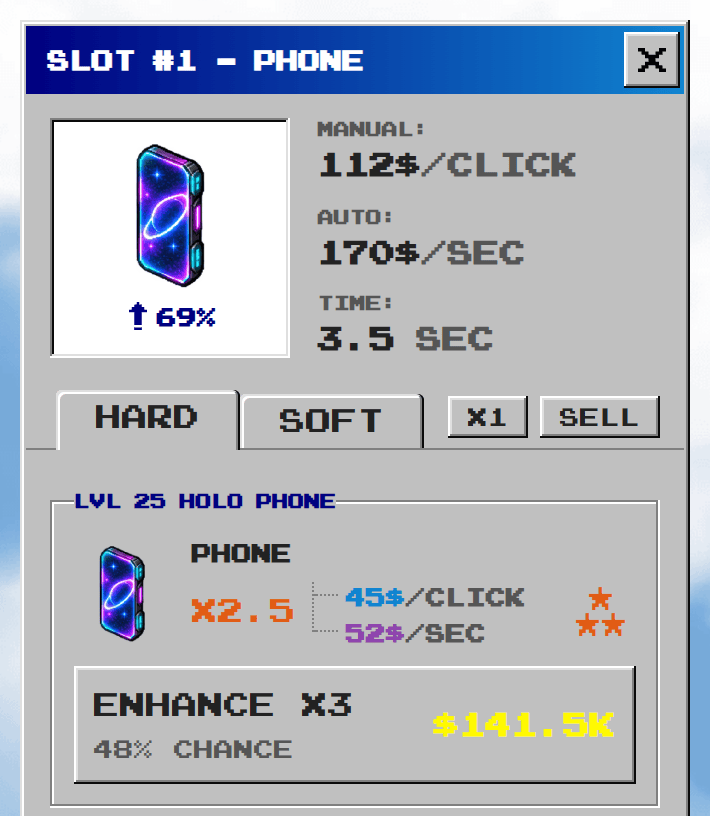 A maxed phone at +3. The button shows the multiplier you’d get next (x3), the chance of success (48%) and the price of the attempt.
The button tells you three things before you commit:
- The next multiplier. Each star raises a part’s multiplier, which applies to everything that part earns, both per click and per second.
- The chance of success. This starts high and drops with every star you already have.
- The price of the attempt. You pay this whether you succeed or not.
When you press it, there are three possible results:
- Success: the part gains one star.
- Great success: a rare roll (5% of successful attempts) gives two stars at once.
- Failed: you lose the money you paid, but you keep every star you already had.
That last point is important. Unlike some games where a failed upgrade can break your item or knock it down a level, a failed Enhance in Spacebar Clicker never takes stars away. The only thing at risk is the money for that one attempt.
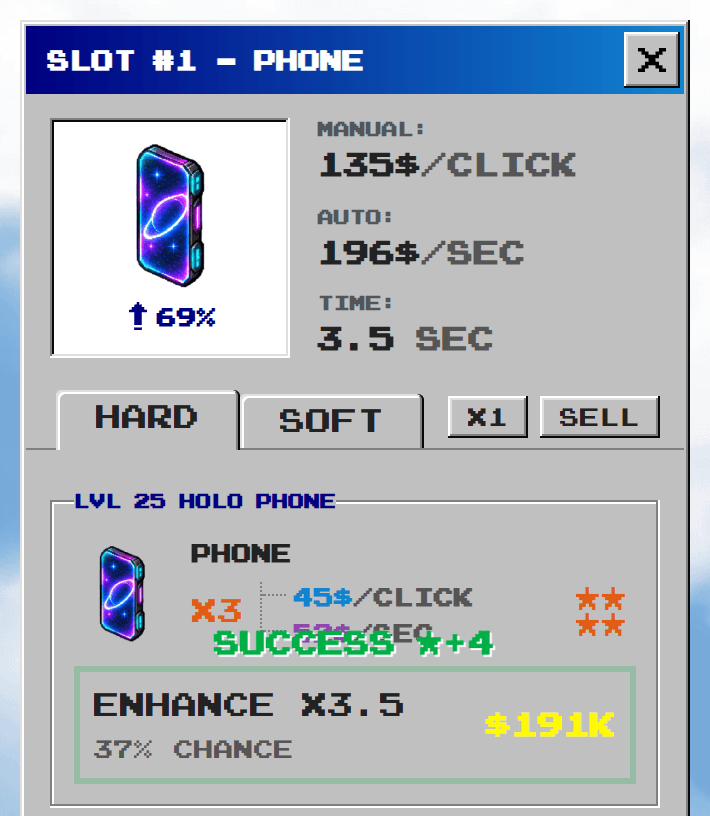 A successful roll: the phone jumps to +4 and x3, and the next attempt gets harder and pricier.
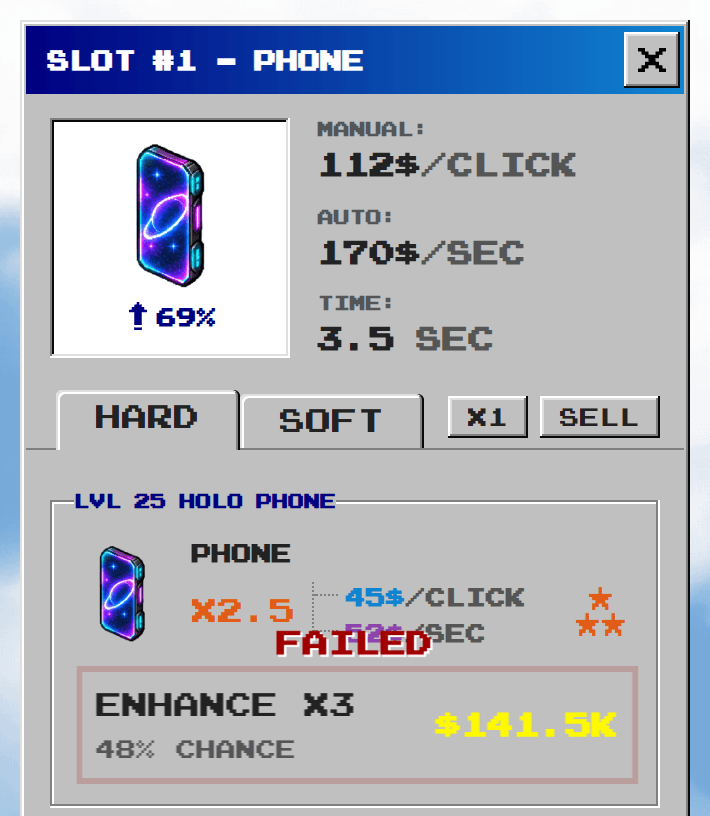 A failed roll. The money is gone, but the three stars stay.
The full numbers
Here is every enhancement step in the game. Attempt prices scale with the price of the part’s final level, so they’re shown as a multiple of that. If a part’s last level cost $10,000, a “1.75x” attempt costs $17,500.
| Step | Chance | Multiplier after | Attempt price | Expected attempts |
|---|---|---|---|---|
| +0 → +1 | 90% | x1.5 | 1.75x | 1.1 |
| +1 → +2 | 73% | x2 | 2.4x | 1.4 |
| +2 → +3 | 60% | x2.5 | 3.2x | 1.7 |
| +3 → +4 | 48% | x3 | 4.3x | 2.1 |
| +4 → +5 | 37% | x3.5 | 5.8x | 2.7 |
| +5 → +6 | 30% | x4 | 7.9x | 3.3 |
| +6 → +7 | 25% | x5 | 10.6x | 4 |
| +7 → +8 | 20% | x6 | 14.3x | 5 |
| +8 → +9 | 16% | x7 | 19.3x | 6.3 |
| +9 → +10 | 13% | x8 | 26.1x | 7.7 |
| +10 → +11 | 10% | x10 | 35.2x | 10 |
Every star you add makes the next attempt 35% more expensive, and the chance of success drops as you climb. “Expected attempts” is the average number of tries you’d need at that step. Some players will hit it first time, others will need twice as many.
Parts that give a speed bonus (shortening a device’s production cycle) work slightly differently: the speed side of their bonus grows by 5% per star instead of using the multipliers above.
Is going to +11 worth it?
Short answer: the first few stars are almost always worth it, the last few only when you have money to burn.
Here’s why. If you multiply each step’s price by its expected attempts, you get roughly what that step costs on average:
- +0 to +3 costs about 10x the part’s final level price in total, and takes the part from x1 to x2.5. That’s a huge boost for the money.
- +3 to +6 costs about another 50x, for x2.5 to x4.
- +6 to +11 costs on average around 790x more, for x4 to x10.
In other words, reaching +11 on one part costs on average about 850 times what its final level cost. The early stars give you far more multiplier per dollar than the late ones. The jump from +10 to +11 is the biggest single multiplier step (x8 to x10), but at a 10% chance it’s also the most expensive by a wide margin.
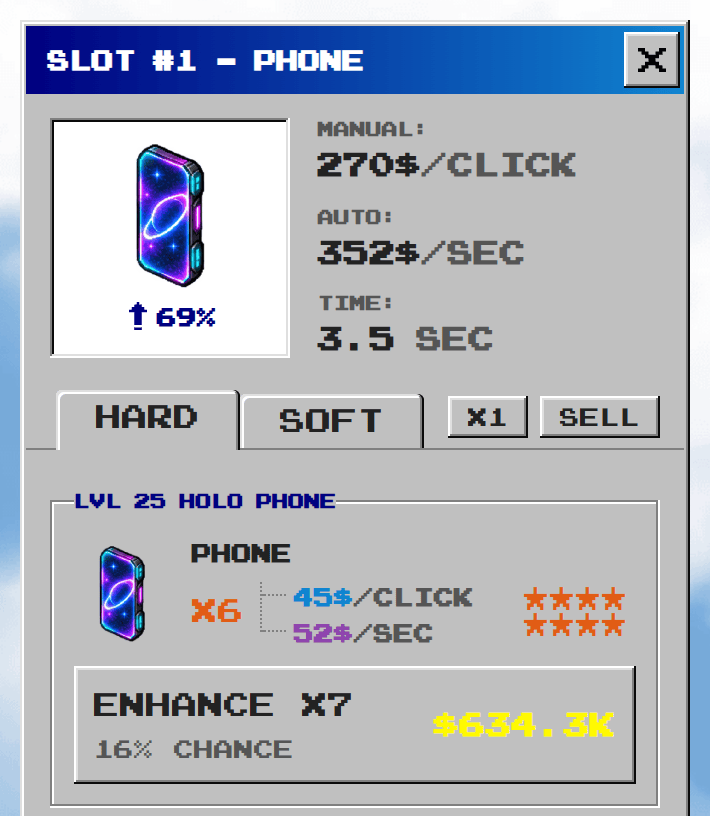 At +8 the phone earns six times its base, but the next star is a 16% shot.
A good rule of thumb: enhance when the expected cost of the next star is less than what you’d pay for an upgrade or device that adds the same amount of income. Early in the game that’s almost never true, because new devices and levels are cheap. Later, when the next room costs tens of millions and every new level is expensive, a couple of cheap early stars on your best parts can be the best deal on the screen.
A simple Enhance strategy
- Start with your strongest parts. A multiplier is worth more on a part that already earns a lot. Enhancing a part that adds $5 per click to x2 gives you $5 more. Doing the same to one that adds $500 gives you $500.
- Take the cheap stars first. Push your best parts to +2 or +3 before going deeper on any one of them. Those steps have 60-90% odds and the best value.
- Set a budget before you roll. Decide how much you’re willing to spend on a part, and stop when you hit it. Chasing a 10% roll with money you needed for something else is how a good session turns into a bad one.
- Don’t sell enhanced parts. Selling a part resets it to level 1 and removes its stars, and money spent on enhancement attempts is never refunded. Treat stars as permanent investments.
- Leave the last stars for later. Once your income is high enough that a 35x attempt feels cheap, the +10 and +11 rolls become a fun side goal instead of a drain.
Why a little RNG makes an idle game better
Pure, predictable growth is satisfying, but it can get a bit flat in the late game, when every purchase is just a slightly bigger version of the last one. A risky upgrade adds moments that feel different: the pause before the result lands, the relief of a success, the “one more try” after a fail.
Because a fail in Spacebar Clicker never takes anything away except the attempt’s price, it stays fun rather than punishing. You’re always choosing how much to risk, and the rest of the game keeps moving forward whether your rolls go well or not.
Quick answers
Is Spacebar Clicker an RNG incremental game? Partly. The core game is fully predictable. Enhance is an optional RNG layer that unlocks once a part reaches its max level.
Can a failed Enhance lose stars? No. A failure only costs the money for that attempt. Your stars stay.
What’s the maximum? +11 stars, which gives a x10 multiplier on everything that part earns.
What’s a “Great success”? A rare success (5% of successful rolls) that adds two stars at once.
Does selling a device refund enhancement costs? No. Selling refunds part of what you spent on levels and the device itself, but never the money spent on enhancement attempts.
Is Click Boost random too? No. Click Boost is a timing challenge. Your results depend on how well you stop the needle, not on luck.
Try your luck
The best way to get a feel for Enhance is to try it on a cheap part first. Open Spacebar Clicker, max out your first phone, and take a swing at that 90% first star. If you want to know how much your clicking speed adds on top, read how fast you can really click next.